
The Securities and Exchange Board of India (Sebi) is in the process of issuing a standard operating procedure (SOP) for designated depository participants (DDPs) regarding disclosures and onboarding of foreign portfolio investors (FPIs), according to a regulatory document seen by Business Standard. DDPs act as a link between the markets regulator and overseas investors. The SOP, framed in consultation with the industry, aims to bring consistency across all players and avoid any form of regulatory arbitrage.

The broader NSE Nifty touched a high of 10,638.35 before settling at 10,584.70 -- up 20.65 points

However, they put in Rs 2,744 crore in the debt markets during the period under review.

Dr Reddy's, Maruti, Bharti Airtel, Bajaj Auto, Infosys, TCS and Bajaj FinServ were the major losers. On the other hand, IndusInd Bank, Sun Pharma, ICICI Bank and HDFC Bank ended with gains.

Top losers include Hero MotoCorp, HDFC, SBI, Infosys, HCL Tech, ICICI Bank, Bajaj Finance, ONGC, Bajaj Auto and IndusInd Bank, falling up to 2.63 per cent.

Among Sensex firms, Power Grid and Tata Steel fell more than 2 per cent. HDFC Bank, State Bank of India, IndusInd Bank, Hindustan Unilever and NTPC were among the major laggards. Nestle, Bajaj Finserv and Bajaj Finance were among the gainers.

'Investors should reduce cash gradually and look for value investing.'

Since MAAFs invest across multiple asset classes, they offer diversification.
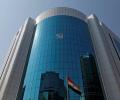
The regulator typically meets overseas investors in the US and UK in the first half of a financial year, and had opted for a virtual meet last year too.

It is to be seen if SBI under Setty, who will have a three-year term, can ride the economic cycle to take SBI to new heights, navigating some of these challenges.

Institutional investors led by foreign portfolio investors have bought these shares.

'As China's reopening euphoria fizzled out on the back of some disappointing economic data, we saw inflows coming back to India with full force in the past 3-4 months.'

'If such inflows materialise, what will be the effect on the rupee's value -- and therefore on exports growth, the only sustainable path to recovery?', asks Mihir S Sharma.

Investments in Indian capital through participatory notes (P-notes) rose to Rs 1.02 lakh crore till October-end, making it the highest level in 43 months.
Not just India, but Asian peers such as Indonesia, South Korea, Thailand, Taiwan and The Philippines have seen sharp FPI outflows this year

Markets hope the Budget will steer spending towards infrastructure.

According to latest data, FIIs have made a net investment of Rs 2,132 crore (Rs 21.32 billion) in the stock markets in December.

In the entire 2017, FPIs put in a collective amount of Rs 2 trillion in equity and debt markets

Axis Bank was the top gainer in the Sensex pack, rising around 3 per cent, followed by Sun Pharma, Reliance Industries, ONGC, HDFC, ICICI Bank, Kotak Bank and Bharti Airtel. On the other hand, Infosys, IndusInd Bank, HCL Tech, Nestle India and Tech Mahindra were among the laggards.
Currently, trades on the Indian stock exchanges are settled within two days, just like most major markets such as Singapore, Hong Kong, Australia, Japan, and South Korea. Indian exchanges, however, will be moving to T+1 settlement from February 25 in a phased manner.

The Adani group will have understood the fragility of investor trust in the group. The group needs to improve transparency including in areas like share-ownership (which they have long and mistakenly believed can be side-stepped) and related-party transactions, among others, Amit Tandon and Hetal Dalal point out.
'The idea is to invest where there is opportunity.'

The US dollar index, which measures the greenback's strength against a trade-weighted basket of six major currencies, was up by 0.31 per cent at 97.52.

The broader NSE Nifty went up to a fresh life-time high of 10,494.45, but failed to stay on the top as it slipped and closed down 19 points, or 0.18 per cent, at 10,444.20.

Neither India nor China will be badly affected by Grexit.

The broader NSE Nifty sank 177.65 points or 1.53 per cent to 11,419.25.

The Securities and Exchange Board of India's (Sebi's) investigation into the Hindenburg allegations is making slow progress when it comes to obtaining information from overseas regulators, particularly around ultimate beneficial ownerships of certain foreign portfolio investors (FPIs), said people in the know. "Establishing ultimate beneficial ownerships for FPIs is a very complex exercise. "Several jurisdictions allow omnibus structures where the end beneficiaries are not required to be captured or are based in some other geographies.

Foreign portfolio investors (FPIs) and mutual funds (MFs) have put in more money as anchor investors in initial public offerings (IPOs) in 2021 than any other year. FPIs' share of investments for the year stood at Rs 24,477 crore, nearly six times that put in last year and more than nine times the amount invested in 2019, the data from Prime Database showed. MFs have invested Rs 12,264 crore, four times than that invested last year and more than 10 times the investment in 2019. The total investment by FPIs and MFs put together this year is five times the amount invested last year. The amount contributed by MFs, however, is nearly half of that invested by FPIs.

Starting with the proposed retrospective amendment to Section 9 of the Income Tax Act, seen as a move to get over the adverse Supreme Court verdict on Vodafone, the controversy spilled over to taxation of foreign portfolio investments and taxation of foreign assets of Indians.

Investors are keenly focused on new govt's first full-year Budget.

The broader NSE Nifty, after cracking the 10,600-mark, ended 82.30 points, or 0.77 per cent, lower at 10,589.10.

The adjustment orders for AY2012, are expected between January and March 2016.

'India has always been a bottom-up stock-picking market, and as growth recovers with higher liquidity, mid and small-caps always tend to outperform.'

The number of draft red herring prospectuses (DRHPs) filed with the markets regulator - Securities and Exchange Board of India (Sebi) - jumped nearly fivefold to 145 in 2021-22 (FY22), compared with just 30 in the preceding financial year (2020-21, or FY21). This was on account of companies rushing to take advantage of a favourable market sentiment towards initial public offerings (IPOs), triggered by an influx of new investors, surge in the secondary market, and encouraging performance of newly listed stocks. In fact, DRHPs filed in FY22 was 4x the previous 10-year average and the highest since 2007-08, according to primary market tracker PRIME Database.

Foreign portfolio investors (FPI) have pumped in a net sum of Rs 49,553 crore in Indian markets this month so far on back of high liquidity coupled with improving global indicators and clarity after the US presidential elections. FPIs invested Rs 44,378 crore in equities and Rs 5,175 crore in the debt segment, taking the total net investment to Rs 49,553 crore between November 3-20. In October, FPIs invested a net sum of Rs 22,033 crore.

Earnings growth, attractive valuations and change in FPI flows from negative to positive over the next 12 months are some of the key triggers for an upside. "A poor monsoon, high inflation and further rate hike are some of the key risks

The broader NSE Nifty shuttled between 10,784.65 and 10,689.80, before ending 21.30 points, or 0.20 per cent, lower at 10,718.05.

Yes Bank was the top performer in the Sensex pack, surging 8.26 per cent, after the private lender reported a 29 per cent rise in its net profit

The value of P-note investments in Indian markets - equity, debt, hybrid securities and derivatives - stood at Rs 74,027 crore till August-end.
The broader 50-issue NSE Nifty edged up just 0.10 points to close at 10,806.60
 © 2026 Rediff.com - Advertise with us - Disclaimer - Privacy Policy - Sitemap - Feedback - About us - Terms of use - Grievances